
What makes a digital dealer believable?
Published: 09.11.2026

Vendula Richter
Head of Marketing

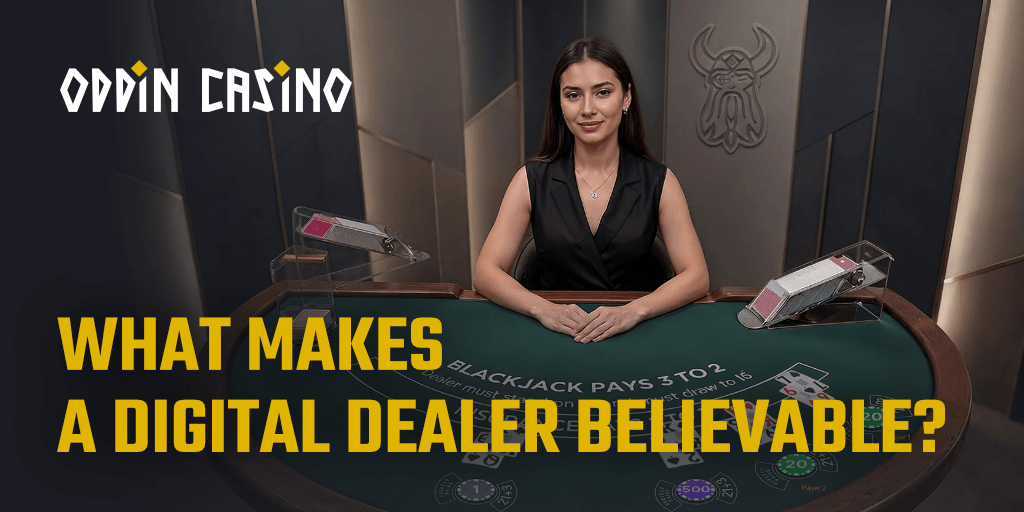
A player sits down at a digital table and looks at the dealer. The face is good. Skin, eyes, hands that look like hands. For the first minute, the illusion holds completely. Then the cards come out and the test changes. That's where the photorealism starts to fade.
Once play begins, players follow the hands as cards are dealt, hear the result called, and notice if the dealer’s reaction fits the moment—and if it happens in the moment. A highly detailed, realistic-looking face is only one part of that experience. If the movement, the voice, and the timing don’t line up, even the best visuals can’t carry the experience.
The evaluation usually starts with a still image. It shows how a character looks. A game shows whether that character belongs at the table.
Looking real is just the start
An experienced casino dealer brings more than a professional appearance. Their gestures make the action clear, their delivery keeps the game moving, and their judgment keeps a natural balance between conversation and concentration. Shouldn’t digital dealers be expected to show the same behaviors?
“A realistic face sets an expectation for everything that follows. If the hands move unnaturally or the voice feels detached from the action, adding more detail to the face will not resolve that. You have to work on the performance as a whole,” says Marek Suchar.
Players watch the hands, too
At a blackjack table, the players watch the cards. That means they are watching the dealer’s hands too. How they reach, how they grip, how they flip, how the card lands on the felt. Together, that is the blackjack experience. Those movements need to make physical sense. A card should maintain convincing contact with the fingers. The dealing motion should match what is seen on the table. Between actions, the hands should settle naturally.
Expressive gestures need purpose too. An open hand can direct attention to a result. On the other hand, an unnecessary flourish can obscure the cards or distract the players. These details matter as much as facial realism because they sit at the center of the player’s focus throughout the game.
The right reaction at the right time
A natural-sounding voice needs delivery that fits the moment. For example, a rules explanation calls for clarity and a measured pace; an unusual hand may warrant more expression. Emphasis, rhythm, emotional intensity—they give the host range, while restraint keeps every announcement from being over the top or dull.
The same goes for how the dealer engages in conversation. If a host invites a response, the player’s contribution has to be considered too. The dealer has to follow up in a way that makes the exchange feel responsive, not rehearsed.
For operators, a follow-up question or an interruption can reveal more than a polished introduction. Does the dealer respond appropriately and return naturally to the game? Its behavior should also stay within clear boundaries, without pressuring players to continue, increase a stake, or chase a loss.
“Operators should ask what a character adds once the initial visual impression has passed. Does its behavior support the experience they want to offer? That is where a branded dealer starts to become more than a visual treatment,” says Suchar.
Why we build our own technology
At Oddin Casino, believability is a design priority for digital Live Dealer. A customized appearance establishes a visual identity. Movement, delivery, and interaction give that identity a presence.
That is why we are building our own proprietary technology across the experience. Developing these elements together gives us control over how the dealer looks, moves, speaks, and responds, and how those behaviors work together within the game. It also means taking responsibility for the complete performance and refining the underlying technology wherever the experience needs it.
We want to stand behind the whole solution. For us, the standard is a dealer that remains convincing when the game is underway.


